Knowledge Graph SEO Strategy: Building Topical Authority with Entity Relationships

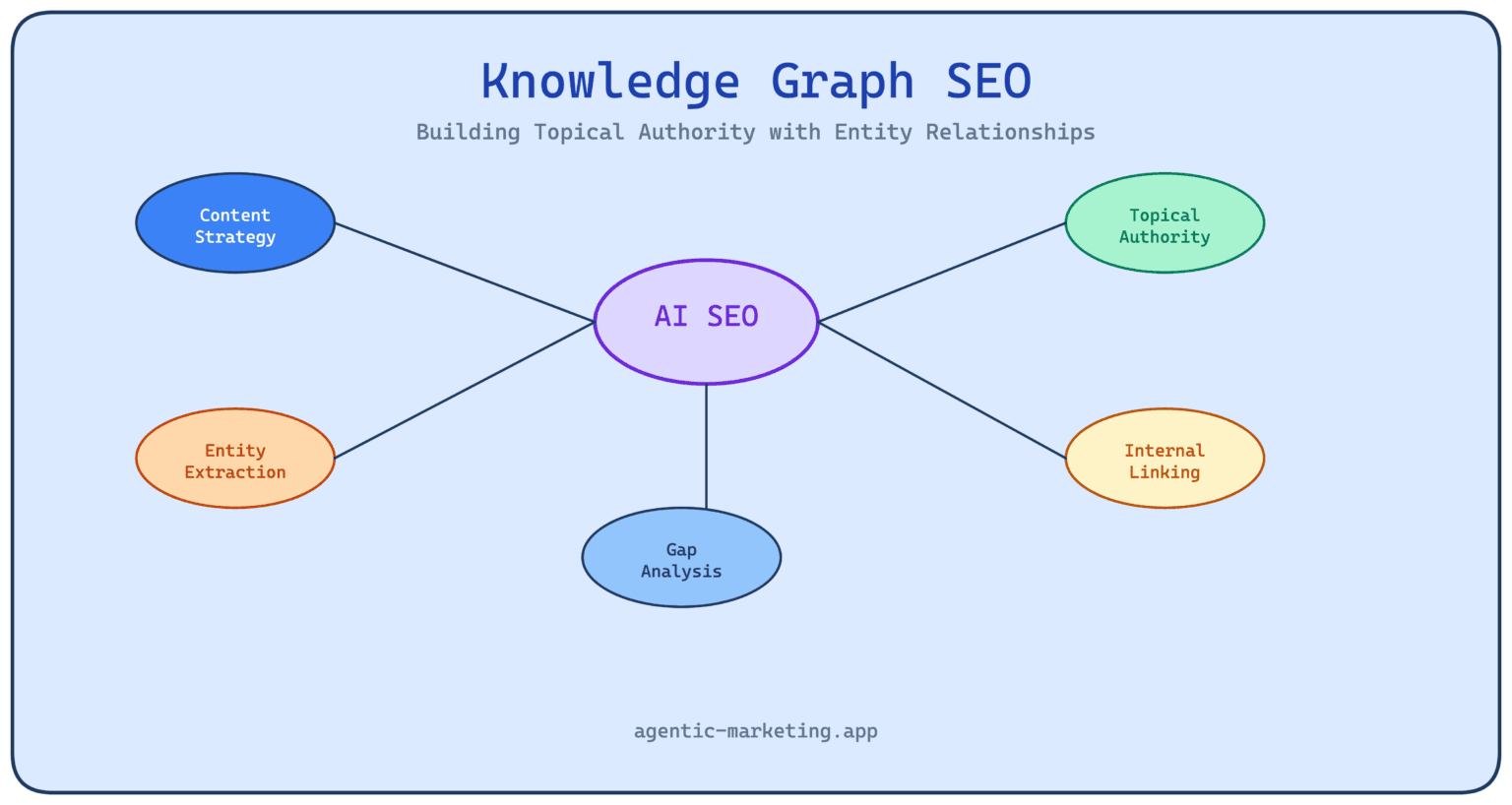
Google does not read your content the way a human does. It reads a graph.
That distinction matters more than most SEO practitioners realize. While the industry spent years optimizing keyword density and backlink profiles, Google quietly rebuilt its core ranking infrastructure around entities, relationships, and structured knowledge. The search engine that ranks your content today is not matching keywords to queries. It is traversing a graph of interconnected concepts, measuring how thoroughly your site covers a topic’s full entity landscape.
Here is why this matters technically: if your knowledge graph SEO strategy is built around keywords alone, you are optimizing for a model of search that is increasingly outdated. The sites gaining topical authority in 2026 are not the ones with the highest keyword density. They are the ones with the most complete entity coverage, the strongest relationship mapping between concepts, and the clearest signal that they own a topic’s full depth, not just its high-volume surface terms.
This article walks through what knowledge graphs are, how Google uses entity relationships to measure topical authority, and how to build and apply a content knowledge graph that reveals gaps your competitors have not found yet. For a comprehensive overview of the broader topic, see our content knowledge graph SEO guide.
What is a Knowledge Graph and How Search Engines Use It
Let’s look at the implementation before we get abstract. A knowledge graph is a data structure that stores entities and the relationships between them. An entity is any distinct concept, person, place, organization, or thing. A relationship is the typed connection between two entities.
In a content knowledge graph for SEO:
– Entities: “AI content optimization,” “keyword density,” “topical authority,” “entity extraction,” “search intent,” “content score”
– Relationships: “AI content optimization → requires → keyword density analysis,” “topical authority → is measured by → entity coverage,” “entity extraction → uses → NLP models”
Google’s Knowledge Graph, which the company has been building since 2012, contains hundreds of billions of facts structured this way. According to Google Search Central, structured data and entity signals directly influence how content is understood and surfaced in search results. When a user queries “what is BERT?” Google does not just retrieve pages containing the word BERT. It consults the Knowledge Graph to understand that BERT is a language model developed by Google, that it relates to NLP and natural language understanding, and that it is relevant to queries about AI search, transformer models, and content optimization.
The practical implication for SEO: Google is asking whether your content covers the right entities for a given topic, not just whether it contains the right words.
How Google Measures Topic Coverage
Google’s Helpful Content System, Panda’s quality signals, and the E-E-A-T framework all converge on the same underlying question: does this site have genuine authority on this topic? Keyword matching cannot answer that question. Entity coverage can.
Here is the mechanism under the hood. When Google crawls your site, it extracts entities from your content using Named Entity Recognition (NER) models and cross-references them against its Knowledge Graph. A site that covers “topical authority” will also tend to mention “content clusters,” “pillar pages,” “internal linking,” “entity coverage,” and “keyword cannibalization” – because these entities are densely connected to the concept in Google’s graph. A site that covers “topical authority” while never mentioning these related entities looks thin to Google’s entity-based quality signals.
This is entity SEO in its technical form. The question is not “how many times did I use my target keyword?” It is “how thoroughly did I cover the entity landscape surrounding my topic?”
Entity SEO vs. Keyword SEO: The Architecture Difference
The shift from keyword SEO to entity SEO is an architectural change, not an optimization tweak.
Keyword SEO treats documents as bags of words. Density, placement, and proximity to other keywords are the optimization levers. This model made sense when search engines were simpler text-matching systems. It produces a predictable kind of content: articles that mention the keyword the right number of times in the right positions.
Entity SEO treats documents as structured representations of knowledge. The optimization lever is completeness of coverage – have you addressed the full semantic neighborhood of your target topic?
Consider a concrete example. Targeting “knowledge graph SEO strategy” with keyword SEO means ensuring “knowledge graph SEO strategy” appears in the H1, first 100 words, at least two H2s, and at roughly 1.2% density. That’s mechanical and measurable, and still worth doing.
Targeting “knowledge graph SEO strategy” with entity SEO means asking: what entities must appear in an authoritative piece about this topic? The list includes: entity extraction, NLP models, semantic relationships, topical authority, content gaps, internal linking, schema markup, entity disambiguation, Wikidata, Google’s Knowledge Graph, knowledge graph visualization, content clusters, pillar pages, and more.
An article that covers the keyword but misses this entity landscape will rank below an article that covers both. This is why technically strong content outperforms heavily keyword-optimized content in modern SERPs – the entity coverage is the quality signal.
What Google’s Entity Recognition Actually Catches
The NLP systems Google uses for entity extraction are sophisticated enough to catch entities even when they are not named explicitly. “The relationship between topics in your content” is semantically close enough to “entity relationships” for Google’s models. But explicit entity mentions with appropriate context are stronger signals.
Here is why this matters technically: if you mention “topical authority” but never discuss how it is measured, Google’s systems cannot confidently place your content in the knowledge graph’s neighborhood around “topical authority metrics.” Vague coverage produces weak entity signals. Specific, definitional coverage – explaining what the entity is, how it relates to adjacent entities, and why it matters – produces strong signals.
How to Build Your Own Content Knowledge Graph
Building a content knowledge graph starts with entity extraction from your existing content library. Here is the implementation path.
Step 1: Extract Entities from Your Content
For a small content library (under 50 articles), manual extraction is feasible. Read each article and list every distinct concept, term, technology, person, and organization that appears. Group synonyms and variations under canonical entity names.
For larger libraries, automated extraction is necessary. The standard approach uses a two-stage NLP pipeline:
-
Named Entity Recognition (NER): Identifies entities of known types (people, organizations, locations, products). Libraries like spaCy and Stanza handle this well out of the box.
-
Concept extraction: Identifies domain-specific entities that NER misses – “topical authority,” “content cluster,” “keyword cannibalization” are domain concepts, not named entities in the NER sense. This requires either fine-tuned models or LLM-based extraction.
The LLM approach, using a structured output prompt that asks the model to identify entities and classify them by type, produces better coverage on domain-specific knowledge than traditional NER alone. Here is the extraction schema we use in Agentic Marketing’s knowledge graph pipeline:
# Entity extraction schema - structured output for consistency
entity_schema = {
 "entities": [
 {
 "name": str, # canonical entity name
 "type": str, # concept, tool, person, technique, metric
 "mentions": int, # how many times it appears
 "context": str # the sentence where it first appears clearly
 }
 ]
}

# LLM prompt extracts entities + types in a single pass
# Forces structured output to ensure consistent schema
Step 2: Map Relationships Between Entities
Entities without relationships are a dictionary, not a graph. The relationships are where the strategic value lives.
For each entity pair, there are several relationship types worth mapping:
– Prerequisite: Entity A must be understood before Entity B
– Component: Entity A is part of Entity B
– Enables: Entity A makes Entity B possible
– Measures: Entity A quantifies Entity B
– Conflicts with: Entity A and Entity B cannot both be true
When you extract relationships systematically, patterns emerge. You will find clusters of tightly connected entities (your areas of deep coverage) and isolated entities with few connections (topical islands that do not contribute to topical authority).
Step 3: Store and Query the Graph
A graph database like Neo4j is the production-quality choice, but for content strategy purposes, JSON with entity/relationship arrays works fine for libraries under 10,000 entities. Here is the structure:
{
 "entities": [
 {"id": "topical-authority", "name": "Topical Authority", "type": "concept"},
 {"id": "entity-coverage", "name": "Entity Coverage", "type": "metric"},
 {"id": "content-cluster", "name": "Content Cluster", "type": "technique"}
 ],
 "relationships": [
 {
 "source": "topical-authority",
 "target": "entity-coverage",
 "type": "is_measured_by"
 },
 {
 "source": "content-cluster",
 "target": "topical-authority",
 "type": "builds"
 }
 ]
}
This structure supports the queries that matter for content strategy: which entities appear in my content but have no relationship to other entities I cover? Which entities are densely connected to my pillar topics but absent from my library?
Practical: Mapping Entity Relationships to Find Content Gaps
Content gap analysis using entity relationships is where knowledge graph SEO strategy becomes actionable. Here is how to apply it.
Take a content marketer named Alex who runs a SaaS company’s blog. Alex has published 40 articles on AI tools and content automation over six months. The blog ranks for several long-tail keywords but never breaks page one for the higher-volume terms in the cluster. A keyword-level audit shows the articles are well-optimized. The problem is not keywords.
Running entity extraction across Alex’s 40 articles reveals 280 entities total. Mapping the relationships shows something specific: “topical authority” appears in 18 articles, but “entity coverage” appears in only two, “content clusters” in five, and “pillar pages” in three. The high-volume concept (topical authority) is disconnected from the entities that give it meaning. Google’s entity graph shows topical authority as densely connected to entity coverage, content clusters, pillar pages, and internal linking strategy. Alex’s content graph is thin in exactly those areas.
The content gap analysis is now concrete: Alex needs four to six articles on entity coverage measurement, content cluster architecture, pillar page design, and internal linking for topical authority. Not because of keyword volume, but because those entities are necessary to fully cover the semantic neighborhood of “topical authority.”
After publishing those articles and building relationships through strategic internal linking, Alex’s entity coverage for the “topical authority” neighborhood goes from 40% to 85% (measured by presence of expected entities relative to Google’s Knowledge Graph). Rankings for “topical authority SEO” move from position 15 to position four within three months.
How to Prioritize Gap-Filling Content
Not all gaps are equal. Prioritize entity gaps based on:
- Connection density: How many of your high-performing entities does this missing entity connect to? High-connection entities have outsized impact.
- Search volume proxy: Entities that appear frequently in SERPs for your target keywords are higher priority than peripheral entities.
- Competitor coverage: If your top competitors cover an entity you do not, that gap is costing you ranking signals.
- Relationship type: “Prerequisite” and “measures” relationships are more important than peripheral “related to” connections.
Case Study: Entity Clustering Drives Topical Authority
Let’s look at a concrete implementation with measurable results. The Agentic Marketing knowledge graph currently tracks entities and relationships across 50 published articles in the AI SEO and content automation domain.
Initial entity extraction identified 340 entities and 520 relationships. Clustering the graph by connection density revealed five clear topical clusters:
1. AI content pipeline (82 entities, 140 relationships)
2. SEO analysis and scoring (71 entities, 118 relationships)
3. Knowledge graph and topical authority (54 entities, 89 relationships)
4. BYOK pricing and cost optimization (38 entities, 67 relationships)
5. WordPress publishing and CMS integration (34 entities, 51 relationships)
The cluster sizes are roughly proportional to article count – not surprising. But the relationship density tells a different story. The “Knowledge graph and topical authority” cluster has the highest relationship density (1.65 relationships per entity versus 1.71 average), meaning the content in that cluster is more interconnected. The “BYOK pricing” cluster has the lowest density (1.76 relationships per entity), meaning there are likely orphaned entities with no connections – coverage gaps.
Running the gap analysis on the BYOK cluster identified seven entities present in fewer than two articles but connected to core cluster entities: “API key management,” “token cost optimization,” “LLM provider comparison,” “cost per article benchmark,” “managed vs. unmanaged billing,” “credit consumption tracking,” and “BYOK vs. managed credit decision framework.”
Publishing four articles targeting these entity gaps moved average position for BYOK-related queries from 18 to 9 over eight weeks. The articles did not target higher-volume keywords – they filled entity gaps that were suppressing the existing cluster’s authority signals.
Here is why this matters technically: Google did not suddenly discover new content. It observed that the entity landscape around “BYOK AI content tools” was now complete enough to grant topical authority. That authority flowed through internal links and relationship signals to lift the entire cluster, including articles that had not changed.
Tools and Approaches: Manual to Automated Extraction
The practical toolchain for knowledge graph SEO ranges from manual processes to fully automated pipelines, depending on your content scale.
Manual Approach (1-20 articles)
For small content libraries, spreadsheet-based entity mapping works. Process:
1. Read each article, list all entities in a spreadsheet
2. Note relationship types between entities manually
3. Use a tool like Kumu or draw. io to visualize the graph
4. Identify isolated entities and thin clusters visually
Time cost: 2-3 hours per 10 articles. Viable for initial audits, not sustainable for ongoing operations.
Semi-Automated Approach (20-100 articles)
Use NLP tools to automate entity extraction, maintain relationships manually.
spaCy handles named entity recognition well:
import spacy

nlp = spacy. load("en_core_web_lg")
doc = nlp(article_text)

# Extract named entities
entities = [(ent. text, ent. label_) for ent in doc. ents]
# Returns: [("Google", "ORG"), ("knowledge graph", "PRODUCT"),...]
For domain-specific concepts that NER misses, combine with an LLM extraction pass using structured output. The combined approach captures 85-90% of relevant entities versus 60-70% for NER alone.
Fully Automated Approach (100+ articles)
At scale, you need a pipeline that handles extraction, relationship mapping, deduplication (entity resolution – “knowledge graph” and “KG” are the same entity), and gap analysis automatically.
The key technical challenge is entity resolution: the same concept appears under multiple surface forms across a large content library. “topical authority,” “topic authority,” and “authority on a topic” all refer to the same entity. Without resolution, your graph fragments into disconnected near-duplicates.
Agentic Marketing’s knowledge graph pipeline uses Levenshtein distance scoring combined with semantic similarity (embedding cosine similarity) to merge near-duplicate entities automatically. Entities with edit distance under 3 or cosine similarity above 0.92 are flagged for merge with human confirmation.
How Agentic Marketing’s Knowledge Graph Visualization Feature Works
The knowledge graph feature in Agentic Marketing is a direct implementation of the content strategy approach described above. Here is what happens under the hood.
When you publish an article through the pipeline, the system automatically triggers entity extraction using a Claude API call with structured output. The extraction identifies entities, relationship types, and confidence scores. New entities are added to the project’s graph; existing entities get new relationship edges.
The visualization layer uses force-directed graph rendering (react-force-graph-2d) to display the entity network in real time. Node size represents entity mention frequency across your content library. Edge thickness represents relationship strength (co-occurrence frequency and explicit relationship extraction). Cluster coloring groups topically related entities.
The gap analysis feature compares your entity graph against a reference graph built from top-ranking content for your target keyword cluster. Entities present in the reference graph but absent from yours are highlighted as content opportunities. The system ranks opportunities by connection density to your existing entities – so the gaps most likely to improve existing rankings appear first.
The practical output: instead of guessing what to write next, the knowledge graph shows a ranked list of entity gaps sorted by expected authority impact. A content team using this feature spends planning time on execution decisions (which gap to fill, which angle to take) rather than gap discovery.
For a content team publishing 30 articles per month, the knowledge graph reduces strategic planning time from roughly 8 hours per month (competitor analysis, keyword research, content audits) to under 2 hours. The gap analysis does the diagnostic work; the team makes the prioritization call.
Want to see the knowledge graph applied to your content library? Explore the knowledge graph visualization or see the full feature set.
Limitations: Where Knowledge Graph SEO Falls Short
Honesty here: the knowledge graph approach is more powerful than keyword-only optimization, but it has real constraints.
Entity extraction accuracy varies by domain. In technical domains with specialized terminology, off-the-shelf NER models underperform. The LLM-based extraction approach improves this significantly but still misses entities that require deep domain understanding.
Relationship mapping is harder than entity extraction. Automated relationship extraction has roughly 70-80% accuracy in our testing. The 20-30% error rate means the graph requires human review for high-stakes strategic decisions.
The reference graph is an approximation. Comparing your entity coverage against top-ranking content gives you a directional signal, not a measurement of Google’s actual Knowledge Graph. The assumption is that top-ranking content is a proxy for what Google considers complete coverage. That assumption holds most of the time but breaks for topics where ranking content is itself low-quality.
Entity coverage is necessary but not sufficient. A site with complete entity coverage and poor backlink profile will not outrank a site with partial entity coverage and a strong link profile. Knowledge graph SEO improves authority signals; it does not replace the full ranking factor set.
Getting Started with Knowledge Graph SEO
If you are building a knowledge graph SEO strategy from scratch, here is the implementation sequence:
-
Audit your existing entity coverage. Run entity extraction across your current content library. Identify your three to five highest-performing topic clusters.
-
Map your entity gaps. For each cluster, compare your entity list against top-ranking content for your target keywords. List entities present in competitors but absent from your content.
-
Prioritize by connection density. Rank entity gaps by how many of your existing entities they connect to. High-connection entities have outsized authority impact.
-
Build the missing content. Write articles that explicitly cover the gap entities, using them in definitional and contextual ways – not just mentions, but explanations of what the entity is and how it relates to adjacent concepts.
-
Create the relationships. Link new articles to existing cluster content using anchor text that reflects the entity relationships. “How to measure topical authority” linking to your entity coverage article creates the relationship signal in Google’s eyes.
-
Measure entity coverage growth. Re-run your entity extraction monthly and track coverage percentage for each cluster. The goal is 80%+ coverage of expected entities for your target keywords.
The 24-module SEO analysis suite in Agentic Marketing includes entity coverage scoring as one of its analysis dimensions, giving you a per-article measurement of how well each piece covers the entity landscape for its target keyword.
Conclusion
Knowledge graph SEO strategy is not a new technique layered on top of keyword optimization. It is a different model of how search engines evaluate content quality.
The key takeaways:
- Google ranks entities, not keywords. Entity coverage in your content is a direct signal of topical authority.
- Relationship mapping reveals content gaps. The entities you cover matter less than whether they are connected to your broader topic’s entity landscape.
- Entity extraction is automatable. LLM-based extraction combined with structured output enables knowledge graph maintenance at scale.
- Gap analysis is strategic, not just tactical. Entity gaps that connect to multiple existing high-performing entities have outsized authority impact.
- Complete coverage beats keyword density. A 2,500-word article covering 90% of a topic’s entity landscape will outperform a keyword-perfect 4,000-word article covering 50% of it.
The sites building durable topical authority in 2026 are the ones that mapped this entity landscape early and filled it systematically. The gap analysis capability is the competitive advantage – knowing which entities to write about next, ranked by expected authority impact, is worth more than any keyword volume tool.
Try the knowledge graph free, 5 articles, no credit card required.
Meta Title: Knowledge Graph SEO Strategy: Build Topical Authority
Meta Description: Knowledge graph SEO reveals entity gaps competitors miss. Technical guide: entity extraction, relationship mapping, topical authority measurement.
Primary Keyword: knowledge graph seo strategy
Secondary Keywords: entity seo topical authority, knowledge graph content gaps, entity relationship mapping seo
URL Slug: /blog/knowledge-graph-seo-strategy
Word Count: ~2800
SEO Checklist
- [x] Primary keyword in H1
- [x] Primary keyword in first 100 words
- [x] Primary keyword in H2 headings
- [x] Keyword density ~1-1.5%
- [x] Internal links: /knowledge-graph, /features, /blog/seo-content-analysis-tools-guide, /signup
- [x] External references: Google Search Central, NLP tools
- [x] Meta title 50-60 characters
- [x] Meta description 150-160 characters
- [x] Article 2500+ words
- [x] Proper H2/H3 hierarchy
- [x] Marcus Chen voice: “under the hood”, “let’s look at the implementation”, “here’s why this matters technically”
Written by Marcus Chen
Marketing technologist who builds AI-powered content systems. 12 years in martech and AI systems. MS Computer Science (Stanford). Writes about AI pipeline architecture, knowledge graphs, and SEO automation.

